


RFID Systems & Solutions
Saving management time, reduced repetitive tasks, and virtually eliminating identification errors enhance productivity across a wide variety of applications in all sectors. RFID identification is an easy system to deploy and manage, with an investment that can be recovered in less than a year.
Increase Your Supply Chain Efficiency with RFID Product Identification
Product and raw material identification and traceability are increasingly important. Having accurate, real-time information is crucial to ensuring product safety and maintaining precise control over your warehouse status. An identification error can reduce productivity or even force you to write off an entire batch, with all the resulting consequences.
To prevent this, the solution is to automate your production and logistics processes. How? By implementing RFID technology.
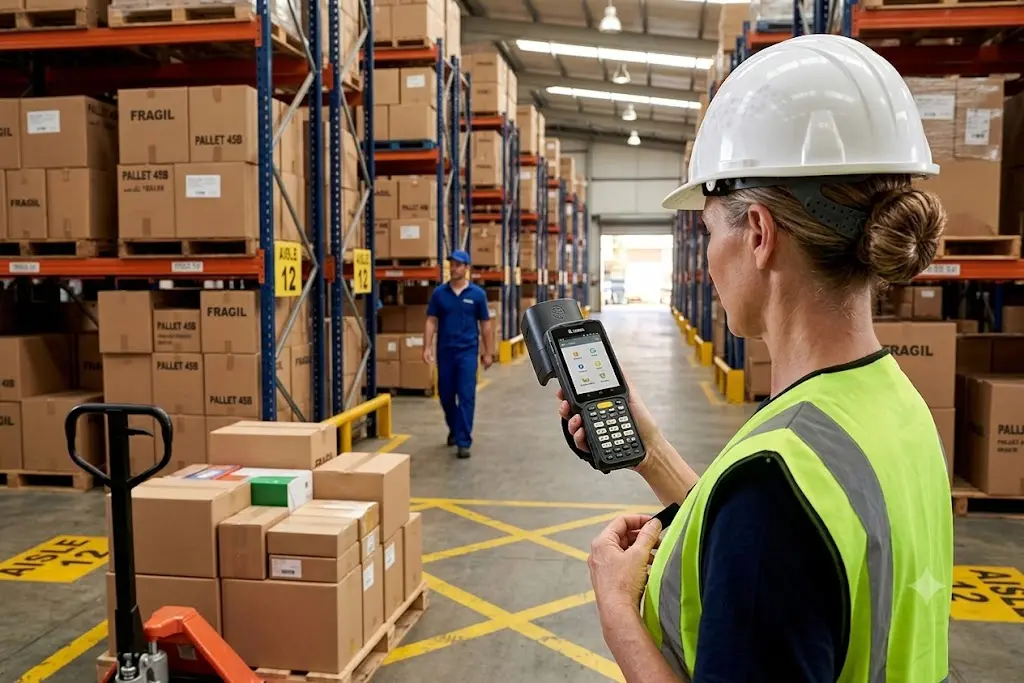
Deploying an RFID solution in your warehouse allows you to know your inventory status in real time. Furthermore, it eliminates human errors in item identification, reading, and classification that could cost you thousands of pounds. Learn more about what RFID technology is and how it works to implement it in your business.
Advantages of RFID Technology
Cost reduction
by preventing losses and shrinkage in products and raw materials
More productive
as many processes are automated
Instant data
for immediate control of inbound goods, dispatches, and locations

No operator required for reads
Simultaneous multi-item identification
Ability to read moving tags
Guaranteed savings and economic efficiency
Long-range identification (+10 metres) without line of sight
Real-time data reading and transmission
Fast read speed: under 100 ms
Reduction in identification errors
Key Features of RFID Technology
Beyond its applications, the true potential of RFID lies in its technical features, designed to solve the most demanding operational challenges in any industrial and logistics environment.
RFID Technology Applications Across Sectors
The versatility of RFID technology enables its application across virtually any sector, optimising processes, reducing costs, and providing unprecedented control over assets and information.

Supply Chain Visibility and Control
RFID technology allows you to know where every item is at all times. It automates inbound and outbound logging in the warehouse, streamlines order preparation, and facilitates fleet management and returnable asset tracking such as pallets or containers.

Patient Safety and Hospital Management
Essential for ensuring every patient receives the correct medication and treatment. RFID enables precise tracking of biological samples and surgical equipment, minimising errors. It also improves hospital asset management and tracking.

Pharmaceutical Traceability
RFID technology helps prevent counterfeit medicines by tracking the journey of each product from the laboratory to final sale. It also enables rigorous control over prescription drugs and manages pharmaceutical supply chain logistics.

Cold Chain Control and Food Safety
Ensures food quality throughout its journey, monitoring the cold chain and managing expiry dates automatically. Furthermore, it tracks product batches to identify manufacturing, distribution, and sales points, enabling targeted recalls if necessary.

Access Control and Data Security
RFID technology reinforces security at all levels. It manages access to facilities and events, tracking visitor numbers, card usage points, and preventing fraudulent entry attempts. Additionally, it protects information with encryption mechanisms to prevent unauthorised copying or reading.

Livestock Control and Management via RFID
In the primary sector, it is a key technology for livestock farm management. It identifies animal health status during lifecycle stages (vaccination records, weight, feed type) and tracks processing post-slaughter.

Automated Laundry Sorting
In industrial laundry environments, RFID transforms daily operations. It automates large-volume garment sorting, tracks wash cycles per item, and manages service lifespan to ensure profitability and service quality.

Flexible Technology for Diverse Fields
RFID flexibility enables application in sports timekeeping, document tracking in large archives and libraries, and secure identification in passports and official documents.
Components of an RFID System
An RFID system comprises various interacting elements delivering instant information. Object data is stored on a tag chip printed on-site using an RFID printer. RFID readers (handheld or fixed units mounted on portals or masts) then capture the tag data.
Reading relies on RFID antennas transmitting data between the tag and reader via radiofrequency waves. Data is then collected by TConnect software, integrating all RFID equipment and converting raw data into actionable insights before forwarding it to the central ERP or Warehouse Management System (WMS) for validation. Integrating RFID solutions with a WMS ensures up-to-date real-time warehouse visibility.



“Tecnipesa’s new RFID-based software solution for managing our warehouses and stores has represented a major step forward in our operational processes. In line with Ay Güey’s vision, and confident that we will continue working with Tecnipesa on the development of new applications, we will be able to grow our business more productively. This will allow us to consolidate our expansion more effectively, both nationally and internationally.”
Other customers who use our RFID solutions









Our Process: Implementing a Successful RFID Project
We understand that adopting new technology raises questions regarding implementation. An RFID solution is far more than the sum of its components; success relies on rigorous planning and execution tailored to each enterprise.
To ensure projects meet defined objectives and deliver tangible return on investment (ROI), Tecnipesa follows a phased implementation plan minimising risk and ensuring a seamless transition.
-
Phase 1: Initial Analysis and Consultancy
Listening and understanding. We thoroughly analyse current processes, workflows, and specific pain points. We jointly define project objectives (metrics, process optimisation) and scope, identifying ideal pilot testing areas if required.
-
Phase 2: Tailored Solution Design
With clear objectives, our engineering team designs an end-to-end solution. This includes selecting optimal hardware (RFID tag types, portals, antennas y fixed readers o mobile readers) and management software or middleware that integrates transparently with existing systems (ERP, WMS). The result is a robust, scalable technology architecture designed for your operational environment.
-
Phase 3: Deployment and Integration
Bringing the project to life. Specialist technicians handle physical equipment installation, configuration, and calibration. Simultaneously, we integrate software with existing systems to ensure automated, seamless data flows. Team training ensures operators manage the new tool autonomously and confidently from day one.
-
Phase 4: Ongoing Support and Maintenance
Relationships extend beyond launch. We provide post-implementation support and maintenance to resolve issues, perform adjustments, and secure optimal long-term performance. We accompany your business evolution, adapting solutions to future needs.
Frequently Asked Questions about RFID Technology
You may also be interested in
-
Products Traceability
The product traceability solution will enable you to track the location of your items throughout the supply chain in real time, ensuring compliance with regulations and preventing losses.